Characters in Victoria Hislop’s, The Return
Sonia, the protagonist, in her 30’s starts dance classes in Clapham, South London. Goes to Granada, with her bestie, Maggie, to improve her Salsa. Miguel, the cafe owner: an elderly proprietor instrumental in the collision of characters past and present. The Ramirez Family: have a cafe in Granada during the Spanish Civil war. Mercedes: youngest of Ramirez’ siblings with Flamenco sitting strongly in her DNA.
Arrival
Like Sonia, I got my first impressions of Granada looking out a taxi window. Reaching the historic quarter there were three storey buildings with overhanging balconies awaiting the geraniums of spring. Residents had already protected their properties from the sun with brown awnings pulled up and over wrought iron railings. The streets were just wide enough for the cab.
My driver dropped me right outside El Granada. I saw the hostel sign and then door displaying Mudejar art. Just in from the short, stone step the heavy wooden facade is decorated with a vivid blue, arabesque pattern. Atop this distinctly Islamic design, is Madonna and child.
I walked in to find, not a hall, but an internal courtyard with white tiled floor, stone pillar and wooden beams. It was filled with an array of greenery in pots, large floor vases and a font; and a small table, wicker chair and a lazy sofa. To the side was a large stairwell. The banister was made of intricate metal railings and the walls whitewashed bar a cross section revealing possible original brickwork. It was an impressive welcome to Andalusia.
When booking it was the high ceiling dorm with man playing guitar that sealed my choice. However, I was late and had been allocated a top bunk. Now, I was in doubt. The others, fortunately, were already out for the evening which gave me time alone to gain mastery of the long ladder. After several practises up and down, I was confident that my knee and agility could cope, Once atop, I enjoyed my lofty position near the roof’s old beams.
My Introduction to Federico Garcia Lorca
Sonia’s guidebook is open on a page about Lorca when she first meets Miguel at his cafe, and it prompts a discussion on the famous poet.
Sonia asked the man if he had ever met Lorca and the waiter told her he remembered seeing him once or twice. ‘Many people here believe that part of this city died with him,’ he added.
‘What do you mean exactly?” she asked, aware the she must respond. ‘When everyone realised what had happened to Lorca-that he had been shot in the back-it gave out the message to all liberal-minded people that it was not safe for anyone and the war in Granada was as good as finished’
Surprisingly, I did not know who he was until I read ‘The Return,’ despite him now being to Granada as Shakespeare is to Stratford upon Avon. The protagonist only knew of him because she saw YERMA in London.

Gypsy Ballads written at The Lorca Garcias’ Summer House in Granada
Following her first meeting with the waiter, Sonia visits Huerta de San Vicente which was the Garcia Lorcas’ summer house. He wrote Gypsy Ballads and YERMA here.
Gypsy Ballads is a collection of poetry highlighting the repression of the marginalised Roma inhabitants in Andalusia. The ballads are metaphorical and colours are used to represent death, mourning and jealousy.
Without knowing it, I knew one of Lorca’s poems, not Gypsy Ballads, but Pequeño vals vienés” which he wrote in New York. Leonard Cohen translated Lorca’s Pequeño vals vienés” using a bit of artistic licence, and created the song Take this Waltz. When riddled with desire and unrequited love, I have listened to Cohen’s husky voice and the 3-4 score and succumbed to sorrow. The experts have analysed Little Vienna Waltz and say it is about the death of Europe at the time. Little did I know.
YERMA written at The Lorca Garcias’ Summer House in Granada
YERMA is based on a baron woman tied to an unhappy marriage due to religion and traditional morals. Sonia and Maggie weren’t keen on the play. However, the story resonates with me. I think it is because religion, and cultural and family values still had a hold in the 1970s and 1980s. My friends and I had religious parents, we went to church youth clubs, and experienced the truth and lies during the AIDS pandemic. Our free minds struggled with religious and pre generational norms. We were on a continuous quest to form a love based relationship that would please. In addition, we strove for a career with meaning. Without one or both of these at thirty meant depressing failure.
Respect to Lorca
I visited Huerta de San Vicente on my first morning. At the end of Conde de Tendillas, with its old properties, I turned to immediately enter the modern with mid 20th century appartment blocks and busy streets connecting to the Camino de Ronda bypass. It is difficult to imagine the Lorca’s moving here to grow fruit and vegetables. I quickened my step until I reached Granada’s largest park which they created in 1992 on the grounds’ of the summer house. Sophia describes the park as a cross between dreary municipal and Elizabethan knot garden. She was correct.
I disliked the openness, sharpness of the trees and hedges; and the brown paths were like a running track. The space needed time to settle and mature. It wasn’t like the parks back home in London which have had had time to grow into themselves.
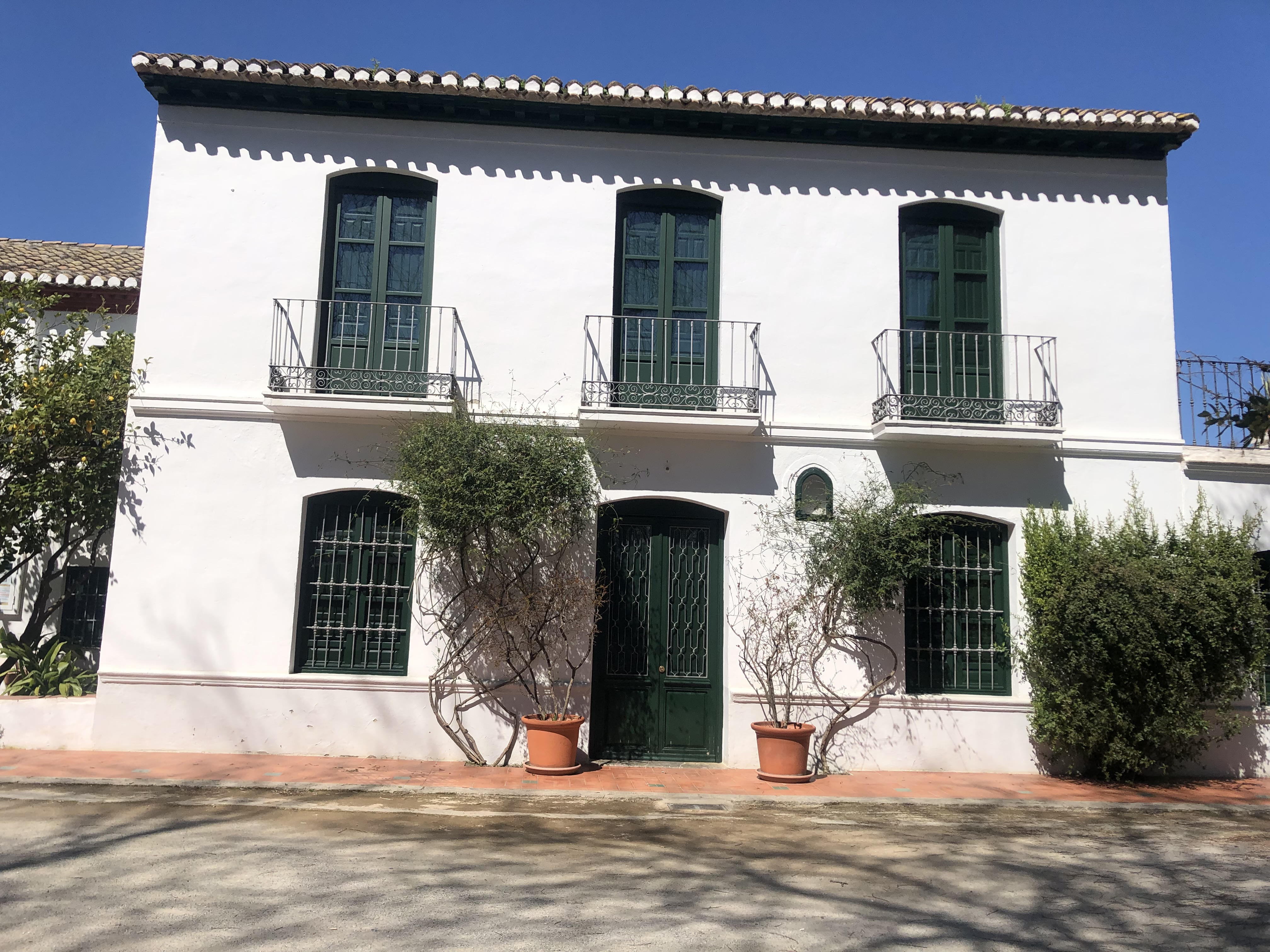
On finding Huerta de San Vicente, I sat on an old, slatted, wooden bench. The bright, cloudless blue sky gave the white cortijo, with its roof of curved clay tiles, a complimentary backdrop. A dormant tree cast spring, spindle shadows on the yard up to the terracotta walkway across the front of the farm house. I saw the shape of a tall man, and two rounder people with arms up ready to dance.
I put in my Bluetooth earphones and listened to Leonard Cohen’s, Take This Waltz.
Plaza de la Trinidad
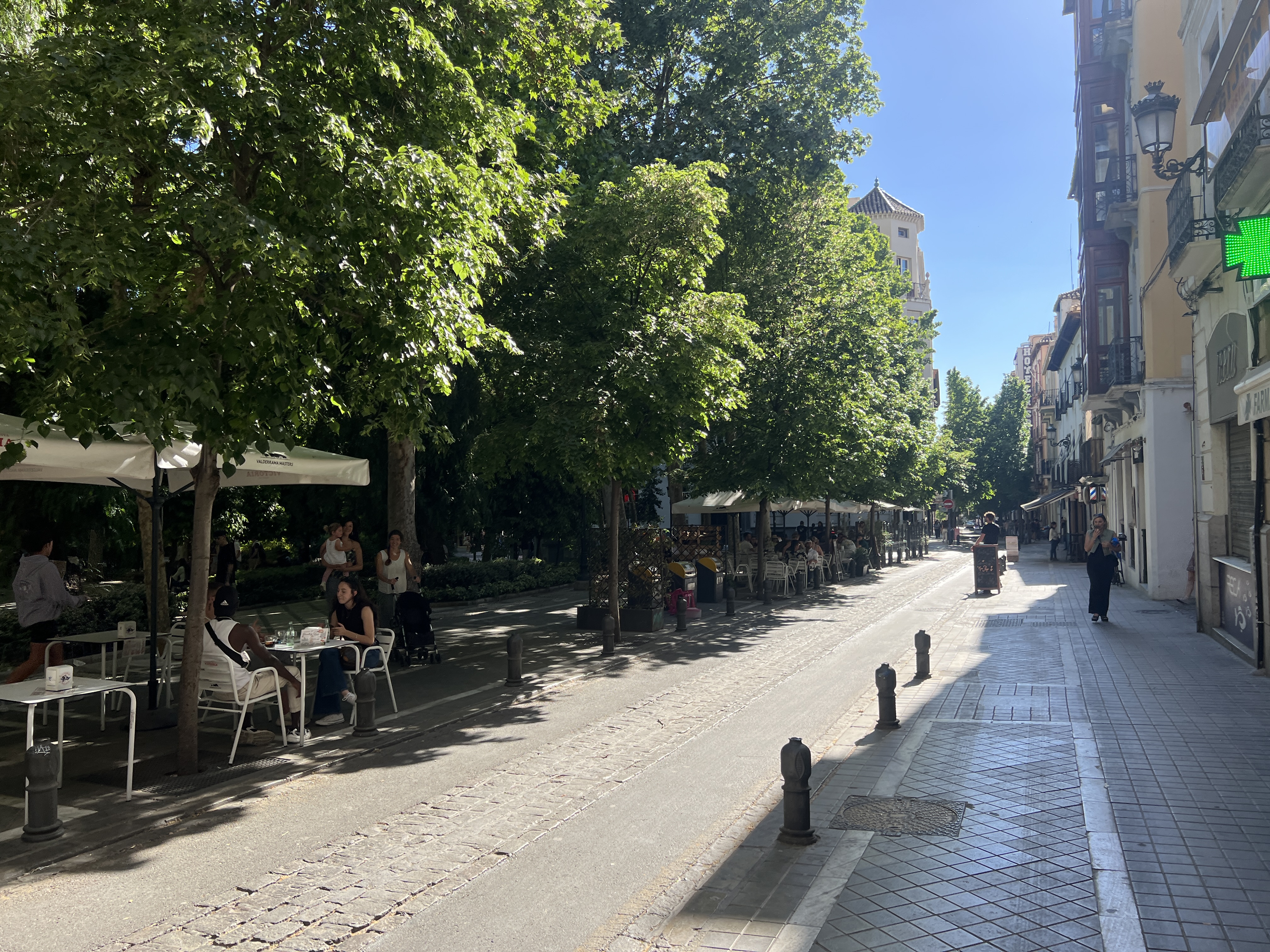
Early morning, Plaza de la Trinidad had been quiet. The only people I saw were those queuing for the artisan bread kiosk to open. Now, at midday, the cafes were alive with customers sitting outside on the edge of the plaza.
The waiter at Plaza Trinidad brought my wine and small tapas from the bar across the narrow street. I was thankful that he didn’t bring anything with egg. My white wine was dry and cool, and paired well with small crisp sticks and dip. I tried to continue with my next read: ‘For Whom the Bells Toll’ by Hemingway, but was distracted by two local, elderly ladies sitting adjacent. Eating out under the parasols in the numerous plazas with fountains was norm for them and they would have enjoyed it their whole lives. I could understand Hislop’s decision to centre the book around a cafe,
They may have thought about me too with my London accent: ‘ She has spent her life in a stable city filled with beautiful parks and lush greenery.’ I pondered: ‘What did they think of Franco; what do they think of modern Granada?
Meeting the Canadian
Snacking on my second tapas, this time bread and spread, I looked up from my book to see a man in beige chinos, shirt and Panama hat. He said, ‘From your hair it is obvious you are not Spanish!’ My recent dye had turned my locks to a more vibrant auburn than normal. He was an expat from Canada, with an Andalusian wife, and seeing me alone he had felt obliged to stop. Our conversation centred on the beauty of modern Granada and particularly for him the ability to ski nearly year round. Sonia found the city as her natural home, and it was apparent the Canadian did too.
I had been fortunate with my pot luck tapas, but not yet so with my fellow flash packers. It had been a day since my last long conversation and I thanked him profusely for stopping.
The man moved away from the table and a moped sped close by. He raised his eyebrows and commented: ‘The safety standards in Spain are poor.’ This surprised me for a country that I thought would be controlled by the rigorous health and safety laws of the European Union.
Change of Plans
The man’s comment about Andalucian safety standards brought to my mind the Adamuz train crash in January. I went back onto my top bunk and checked my booked train to Antequera and connection on to Ronda. They were renovating tracks all over the region.To get to Ronda in time for my arranged Airbnb check in, I would have to get a train out to Antequra at 6:30 am then wait 3 hours for a connection. The connection would now be by bus and not as picturesque as the train ride. Antequera with a strong coffee, a pastry and my book seemed ok. In hindsight I should have done some research on station facilities.
One response to “An inter-generational plot for authentic travel in Andalucia (1)”
-
[…] At Huerta San Vicente I had respected a man whose life was changed by the Spanish Civil War. I did the same at Patio de los Arrayanes (Court of the Myrtles), Standing by the pond looking up toward Palace of Comares, I thanked the conservator Leopoldo Torres Balbas for his authentic restorations which have survived 100 years. His myrtle bushes are still being manicured and the pond remains still as glass. […]
As an Amazon Associate I earn from qualifying purchases.
Leave a Reply